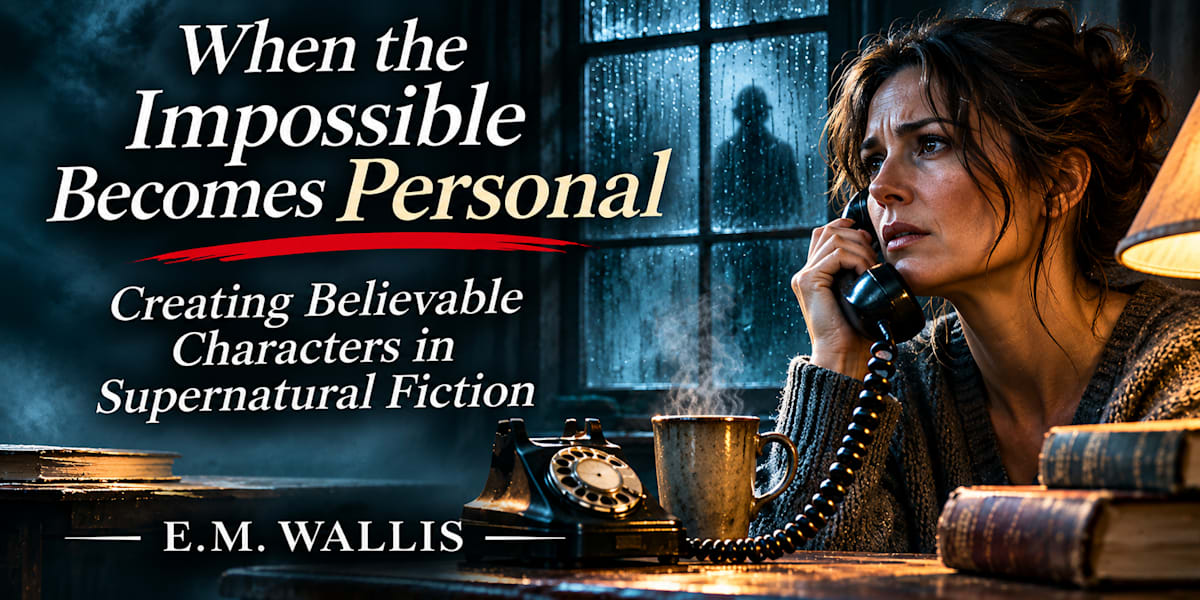
Ghosts, visions and mysterious telephone calls might draw readers into a supernatural mystery, but it's the people caught up in those extraordinary events who make them care. Author E.M. Wallis explores why believable characters are at the heart of the stories we remember.
It starts with a person, not a ghost
Imagine receiving a telephone call from someone who died twenty years ago.
You recognise the voice. You know the person is dead. Yet they're speaking to you as clearly as if they were sitting in the next room.
What would you do?
Perhaps you'd hang up, convinced someone was playing a particularly unpleasant practical joke.
You might demand to know who was calling, or ask questions that only the person you remembered could possibly answer.
Or perhaps you'd simply sit there, unable to speak, trying to make sense of something that shouldn't be happening.
That's the interesting part of supernatural fiction for me.
Not the impossible telephone call itself, but the person answering it.
When I'm writing a supernatural mystery, I don't begin by asking how frightening I can make the ghost, the vision or the unexplained event.
I'm more interested in how someone might react when an experience challenges everything they believe about the world.
Because however extraordinary the circumstances become, the characters need to remain recognisably human.
And human beings are wonderfully complicated.
The problem with perfectly sensible characters
There's a familiar moment in supernatural fiction when a character hears a disturbing noise coming from a darkened room.
Naturally, they decide to investigate.
Readers, meanwhile, are probably thinking something along the lines of, "Don't be ridiculous. Get out of the house."
I've certainly had that reaction myself.
But there's a difficulty here for writers. If every character behaves with complete rationality, exercises perfect judgement and immediately removes themselves from danger, a great many supernatural stories would be over before they'd properly begun.
The answer isn't to make characters foolish.
It's to give them believable reasons for making decisions that might otherwise seem unreasonable.
Perhaps the character has heard a child crying and believes someone needs help.
Perhaps they're searching for a missing relative.
Or perhaps the disturbing sound comes from a room associated with someone they loved and lost.
Suddenly, walking towards the noise becomes understandable.
The decision might still be dangerous, but we can see why they've made it.
That's an important distinction.
Readers don't necessarily need to agree with a character's choices. They need to understand them.
And sometimes, the choices that seem least sensible from the outside make perfect emotional sense to the person making them.
When the past refuses to stay buried
I've always been interested in the way our experiences shape our understanding of the present.
Two people can witness exactly the same event and come away with very different interpretations.
One might see a coincidence. Another might believe they've witnessed something supernatural.
Their reactions will depend on what they know, what they've experienced and what they're prepared to believe.
This is particularly useful in supernatural fiction because the unexplained rarely arrives in a vacuum.
Characters bring their memories, relationships, regrets and fears into the story.
And those things influence what happens next.
In my novel The Last Caller, Jacob works for a bereavement support service.
His working life involves listening to people who are struggling with loss. He understands that grief can affect people in complicated and sometimes unexpected ways.
Then he receives a telephone call from a woman who should be dead.
The premise is supernatural, but the mystery becomes personal as Jacob begins uncovering connections to a devastating fire and secrets surrounding his own family.
I wanted the impossible call to do more than provide an intriguing opening.
It needed to challenge Jacob's understanding of his life.
The questions he faces aren't simply about who is calling him or how such a conversation could take place.
They're also about trust, identity and the uncomfortable possibility that important parts of his history have been concealed from him.
For me, those human questions are what give the supernatural mystery its emotional weight.
A ghost might make someone frightened.
Discovering that the people you trusted have been keeping secrets can change your entire understanding of who you are.
Discover The Last Caller on Amazon
Why characters need something to lose
One of the most important questions I ask when developing a story is surprisingly simple.
Why does this matter to the character?
It's easy to create an intriguing mystery.
A body is discovered. Someone disappears. A strange figure appears in a photograph. A voice is heard in an empty building.
Any of those could provide the beginning of a story.
But the mystery becomes much more compelling when the person investigating it has something at stake.
Perhaps they're trying to clear their name.
Perhaps the truth could destroy an important relationship.
Or perhaps they're desperate to discover what happened to someone they loved.
In Whispers in the Fog, Lillie's psychic visions draw her into a murder mystery on Misthaven Island.
Her experiences create uncertainty because they suggest knowledge she cannot easily explain.
But the situation becomes considerably more serious when suspicion begins to fall upon her.
She isn't simply trying to understand her visions.
She's caught up in events that threaten her future and her relationships with the people around her.
That changes the nature of the story.
A character investigating a mystery out of curiosity can always decide to walk away.
A character whose life is being affected by the mystery may not have that luxury.
And when the stakes become personal, the reader has a much stronger reason to keep turning the pages.
Discover Whispers in the Fog on Amazon
Fear is rarely straightforward
Something else I've noticed, both in life and in fiction, is that people don't always respond to frightening situations in the way we expect.
Some become quiet.
Others talk incessantly.
Some make jokes, even when the circumstances are anything but amusing.
And a few appear remarkably calm until the danger has passed.
There's no single correct way to react to fear.
That gives writers an enormous amount of freedom, but it also creates a responsibility to understand their characters.
A person who has experienced significant loss might respond differently to an apparent message from the dead than someone who has never encountered bereavement.
A character who prides themselves on being rational might struggle to accept an experience that has no obvious explanation.
Someone who already believes in the supernatural might be more willing to investigate, but that doesn't mean they'll be any less frightened.
I find those differences fascinating.
They also help prevent characters from becoming little more than vehicles for moving the plot forward.
If everyone responds to the same situation in exactly the same way, the story begins to feel artificial.
Real people disagree. They misunderstand one another. They make assumptions, conceal their feelings and occasionally say completely the wrong thing.
Sometimes they even laugh when they probably shouldn't.
Those imperfections are part of what makes them believable.
And believable characters make extraordinary events considerably more convincing.
The danger of explaining too much
One of the temptations when writing supernatural fiction is to explain everything.
Why the ghost appears.
How the visions work.
What caused the strange event.
And exactly what every character is thinking and feeling.
But I think mystery needs a little room to breathe.
Readers enjoy making discoveries for themselves.
They notice details, form theories and gradually assemble their own understanding of the story.
The same applies to characters.
If a character tells us they're frightened, we understand the information.
But if they hesitate before answering a telephone, check that a door is locked for the third time or deliberately avoid looking towards a darkened window, we begin to experience their unease.
Those small actions can reveal more than a paragraph explaining their emotions.
I enjoy working with those details.
A character might insist they don't believe in ghosts, then leave every light on before going to bed.
Someone might dismiss a strange experience as coincidence, yet find themselves returning to it again and again.
Their words tell us one thing.
Their behaviour tells us another.
And the gap between the two can be particularly revealing.
Ordinary people in extraordinary situations
I don't think a supernatural mystery necessarily needs a character with unusual abilities.
Sometimes, the most compelling person to place at the centre of a story is someone whose life is completely ordinary.
They have a job, relationships, responsibilities and problems that have nothing to do with ghosts.
They worry about money, family, work and whether they've remembered to put the bins out.
Then something happens that changes everything.
The contrast matters.
When the world surrounding a character feels familiar, an impossible event becomes much more striking.
That's one reason I enjoy placing supernatural mysteries within recognisable everyday circumstances.
A telephone conversation at work.
A familiar street.
A photograph.
A room someone has entered hundreds of times before.
The extraordinary doesn't need to announce itself with thunder and lightning.
Sometimes it simply interrupts an ordinary Tuesday.
I explored the importance of these familiar surroundings in my previous article, When ordinary places become extraordinary: The importance of setting in supernatural fiction.
But setting and character are closely connected.
A familiar place becomes unsettling because of what it means to the person experiencing it.
An empty house might be frightening to one character and comforting to another.
A telephone ringing in the night might be an irritation, a source of hope or the beginning of something terrifying.
The object or location hasn't changed.
The meaning has.
The people who don't believe
There's another type of character I particularly enjoy in supernatural fiction.
The sceptic.
Every good supernatural mystery benefits from someone prepared to question what everyone else believes.
Perhaps they're convinced there's a rational explanation.
Perhaps they suspect someone is lying.
Or perhaps they've experienced something themselves but are determined not to acknowledge it.
Sceptical characters can create useful tension because they force others to examine their assumptions.
But I think they work best when their doubts are genuine rather than simply obstructive.
After all, if someone told you they'd received a telephone call from a dead person, you probably wouldn't accept the claim without asking a few questions.
I certainly wouldn't.
My journalism background has probably influenced that aspect of my writing.
I've spent much of my professional life asking questions, checking information and trying to establish what actually happened.
Those habits don't disappear when I sit down to write fiction.
In fact, they're particularly useful when developing a mystery.
What evidence does the character have?
What assumptions are they making?
Who might benefit from concealing the truth?
And what alternative explanation has everyone overlooked?
The supernatural element introduces uncertainty, but the investigation still needs to feel credible.
A convincing sceptic helps maintain that balance.
Giving characters room to change
A good supernatural mystery should leave its central character somewhere different from where they began.
That doesn't necessarily mean a happy ending.
Nor does it mean every question must be answered.
But the experience should matter.
Perhaps the character has discovered an uncomfortable truth.
Perhaps they've confronted a memory they've spent years avoiding.
Or perhaps they've realised that their understanding of the world was less certain than they believed.
Sometimes, the change is subtle.
A character who began the story refusing to believe in anything supernatural might finish it with a little more uncertainty.
They may never admit what happened.
They may never discuss it again.
But the next time they hear an unexplained noise in an empty house, perhaps they'll hesitate before dismissing it.
I like that sort of ending.
It allows the mystery to continue beyond the final page, at least in the reader's imagination.
And that can be far more satisfying than explaining every last detail.
What short stories have taught me about character
Writing a short story creates a different challenge.
In a novel, there's time to develop relationships, explore backstories and gradually reveal what motivates the characters.
A short story doesn't offer the same luxury.
Every scene has to work harder.
When I wrote GHOSTED, I wanted to create an atmospheric supernatural mystery that readers could enjoy in a single sitting.
That meant being selective about what the reader needed to know.
You don't necessarily need a character's complete life history to understand them.
Sometimes, one decision can reveal something important.
A moment of hesitation.
An unexpected reaction.
A refusal to answer a question.
A choice that places someone else before themselves.
Those details can establish personality surprisingly quickly.
They also remind me that character development isn't simply about adding more description.
It's about choosing the right information and revealing it at the right moment.
If you're interested in the thinking behind the story, I've written more about it in GHOSTED: The story behind my supernatural mystery.
The real mystery is often human
The more supernatural fiction I write, the more convinced I become that the unexplained is only part of the story.
Ghosts, visions and impossible events provide wonderful opportunities for mystery.
But they're often most effective when they reveal something about the living.
A hidden resentment.
An unresolved loss.
A relationship built on secrets.
A decision someone regrets.
Or a truth that has remained concealed for so long that revealing it threatens everything a character believes.
Those are the things that interest me.
And they're often the questions that stay with readers after the supernatural mystery itself has been resolved.
I explored a related idea in The psychology of fear: Why the unseen frightens us most.
Our imaginations play an enormous role in the way we experience fear.
But so do our memories, expectations and personal experiences.
The same shadow can mean something very different to two people.
And the same impossible event can change their lives in entirely different ways.
That's why I believe character and mystery need to develop together.
The supernatural event gives the character a problem.
The character's history and personality determine how they respond.
And their decisions shape the story that follows.
Discover my supernatural mysteries
If you enjoy supernatural fiction where the characters and their personal histories are as important as the unexplained events surrounding them, you might like to explore my books.
Whispers in the Fog
On the isolated Misthaven Island, Lillie's psychic visions draw her into a murder mystery where hidden secrets and growing suspicion place her in danger.
Read Whispers in the Fog on Amazon
The Last Caller
A bereavement support worker receives an impossible telephone call that leads him towards a devastating fire, concealed family relationships and disturbing truths about his own past.
Read The Last Caller on Amazon
GHOSTED
An atmospheric supernatural mystery short story exploring the unsettling space between ordinary life and the unexplained.
You can also find more articles about supernatural fiction, storytelling and the inspiration behind my books on my author website.
One final thought
Imagine that telephone ringing again.
The caller is someone who should be dead.
You recognise the voice.
You know the conversation is impossible.
Now forget, for a moment, about ghosts and the supernatural.
Think about the person holding the telephone.
What do they remember about the caller?
What did they leave unsaid?
What would they give for one more conversation?
And what might they discover if they continued listening?
That's where the story really begins.
Because the impossible might capture a reader's attention, but it's the human consequences that keep them turning the pages.
A ghost can haunt a house. A secret can haunt a lifetime.
And sometimes, the second is far more unsettling than the first.
E.M. Wallis
Author of Whispers in the Fog, The Last Caller and GHOSTED