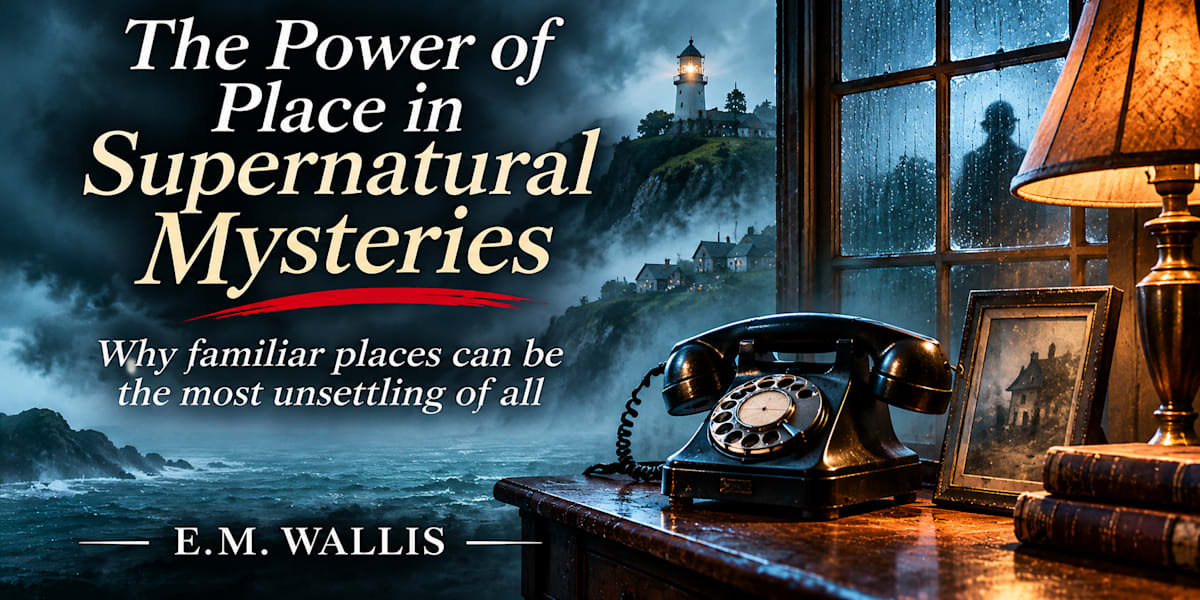
An isolated island, a familiar room, a telephone ringing in the middle of the night. Supernatural mystery author E.M. Wallis explores why the places we know can sometimes become the most unsettling places of all.
A perfectly ordinary place
There's something rather unsettling about walking into a familiar room and feeling that something isn't quite right.
Nothing has changed. The furniture is where it should be. The windows are closed. The clock is ticking away on the mantelpiece.
Yet something feels different.
Perhaps it's the silence. Perhaps it's a shadow you don't remember seeing before. Or perhaps it's simply that peculiar sensation of being watched when you know you're alone.
Most of us have experienced something like this at one time or another. We usually dismiss it, put the kettle on and get on with our day.
But as a writer of supernatural mysteries, I tend to do something rather different.
I start wondering what might happen next.
What if the feeling doesn't go away? What if the room really has changed, but in a way that's almost impossible to identify? What if someone else walks in and notices exactly the same thing?
Before long, an ordinary room has become the beginning of a story.
And that's what fascinates me about setting. It doesn't have to be spectacular, ancient or even particularly interesting to become the most important place in a supernatural mystery.
Sometimes, the more ordinary it is, the better.
Why familiar places can be frightening
We tend to associate certain places with safety.
Our homes, workplaces and favourite walking routes are familiar. We know what to expect from them, and that familiarity gives us a sense of control.
When something happens that challenges those expectations, it can be deeply unsettling.
Imagine returning home to discover that a photograph has moved. Not disappeared, just moved a few inches along the mantelpiece.
You live alone.
You know you didn't move it.
There are several perfectly reasonable explanations, of course. Perhaps you knocked it while cleaning. Perhaps your memory isn't quite as reliable as you think.
But what if it happens again?
And again?
Suddenly, the place where you feel safest has become somewhere you no longer entirely trust.
I think that's one of the reasons supernatural stories set in ordinary surroundings can be so effective. Readers don't have to imagine themselves in some extraordinary location. They can picture the events happening in their own homes.
A creaking staircase becomes their staircase. A darkened window becomes the one overlooking their garden.
The story follows them out of the book and into the real world.
That's a powerful thing for a writer to achieve.
The isolation of an island
Of course, there are times when the setting itself provides an opportunity to create tension.
In my novel Whispers in the Fog, the story unfolds on Misthaven Island, where Lillie's disturbing psychic visions draw her into a murder mystery.
An island is a particularly interesting setting because it creates a natural sense of separation.
There's the physical distance from the mainland, but there's also the psychological effect of being somewhere with its own community, history and secrets.
People who live in isolated communities often know a great deal about one another. At least, they think they do.
And that creates wonderful possibilities for a mystery writer.
What happens when someone discovers that a familiar neighbour isn't quite the person everyone believed them to be? What if a secret has been kept for generations? What if someone knows the truth but has very good reasons for remaining silent?
The supernatural element adds another layer of uncertainty.
Lillie's visions offer glimpses of things she cannot easily explain, leaving her to question what they mean and whether she can trust them.
The island becomes more than a backdrop. Its isolation, atmosphere and sense of hidden history contribute to the mystery itself.
I also happen to love fog as a storytelling device.
It changes familiar surroundings, conceals details and makes distances difficult to judge. Something that would be perfectly ordinary on a clear afternoon can become surprisingly threatening when it emerges from a bank of mist.
And, of course, there's always the question of what might be waiting just beyond it.
Discover Whispers in the Fog on Amazon
The extraordinary hiding inside everyday life
One of the things I enjoy most about supernatural fiction is the opportunity to introduce something impossible into an otherwise believable world.
The extraordinary becomes much more convincing when everything surrounding it feels real.
Think about the objects we use without giving them a second thought.
A mobile phone. A television. A photograph. A letter that arrives in the post.
We understand what these things are supposed to do.
But what happens when they behave in a way they shouldn't?
That question lies at the heart of my novel The Last Caller.
Jacob works for a bereavement support service, where telephone conversations are an ordinary part of his working life. He listens to people who are grieving, offering support at some of the most difficult moments they will ever experience.
Then he receives a call from a woman who should be dead.
It's an impossible situation, but the means by which it happens is entirely ordinary.
A telephone rings.
Someone answers.
A conversation begins.
I like that contrast. There's no need for a spectacular supernatural event. The mystery begins with something that happens thousands of times every day.
But the identity of the caller changes everything.
As Jacob searches for answers, he begins uncovering connections to a devastating fire, concealed family relationships and secrets from his own past.
The familiar world he thought he understood becomes increasingly uncertain.
For me, the most interesting part of that premise isn't simply the mysterious call. It's the effect the call has on Jacob.
How would any of us react if something apparently impossible challenged everything we believed about our own lives?
Would we search for a rational explanation?
Would we tell someone else?
Or would we begin to question our own judgement?
Those are the questions that make the story interesting to me.
Discover The Last Caller on Amazon
Creating atmosphere without overdoing it
There's a temptation when writing supernatural fiction to make every location dark, abandoned and threatening.
Crumbling buildings. Howling winds. Thunderstorms. Doors slamming in the night.
And there's nothing wrong with any of those things when they're used well.
However, I think atmosphere can be much more effective when it's subtle.
An ordinary house on a bright summer afternoon can be just as unsettling as an abandoned mansion at midnight, provided something happens that makes the reader question what they're seeing.
Sometimes, a single detail is enough.
A chair facing the wrong direction.
A light burning in a house that's supposed to be empty.
A familiar voice coming from somewhere it shouldn't.
These small disturbances work because they interrupt our expectations.
As a writer, I enjoy deciding which details to include and which to leave to the reader's imagination.
Describe everything, and there's very little mystery left.
Describe too little, and the reader may struggle to picture the scene.
The trick is to provide enough information to make the place believable, then introduce something that doesn't belong.
And resist the temptation to explain it immediately.
Why short stories need strong settings
Writing a supernatural mystery in a short format presents its own challenges.
With a novel, there's time to develop locations, introduce characters and gradually build an atmosphere of unease.
A short story has to work much harder.
The reader needs to feel immersed in the world almost immediately.
That's something I considered when writing GHOSTED, my supernatural mystery short story.
I wanted to create an experience that readers could enjoy in a single sitting, while still giving them a sense of mystery and atmosphere.
Short fiction demands a certain discipline. Every description has to earn its place, and the setting needs to contribute to the story rather than simply provide somewhere for the characters to stand.
I think there's something particularly satisfying about a short mystery that stays with the reader after the final page.
You finish reading, put the book down and return to whatever you were doing.
Then, perhaps an hour later, you find yourself thinking about something that happened in the story.
A detail you hadn't considered.
A question that wasn't completely answered.
Or an ordinary object that suddenly seems just a little less ordinary.
That's the sort of reaction I enjoy creating.
If you'd like to know more about the thinking behind the story, I've also written about it in GHOSTED: The story behind my supernatural mystery.
The places we carry with us
My background in journalism has probably influenced the way I think about locations and the people who inhabit them.
Every place has a story.
A quiet street might have witnessed extraordinary events. An ordinary building might hold memories that mean something very different to the people who have passed through it.
Two people can stand in exactly the same place and experience it in completely different ways.
For one person, a house might represent security and happiness. For another, it might be associated with grief, regret or a painful memory.
The building hasn't changed.
But its meaning has.
That's an idea I find particularly interesting when writing fiction, because a location can reveal as much about a character as their dialogue or actions.
A person returning to their childhood home might notice things that a stranger would overlook. An unfamiliar room might trigger a memory. A place associated with loss might become somewhere a character has spent years trying to avoid.
When supernatural elements are introduced, those emotional connections can make the mystery even more compelling.
A haunting doesn't necessarily have to be about a ghost.
It might also be about the past refusing to stay where it belongs.
Letting the reader do some of the work
One of the great pleasures of reading is that no two people imagine a fictional setting in quite the same way.
I can describe a narrow corridor, a wooden staircase and a half-open door, but every reader will construct a slightly different picture.
Some will imagine an old Victorian house. Others might picture somewhere they've lived or visited.
And that's where the magic happens.
The reader brings their own experiences, memories and fears into the story.
As a writer, I can suggest that something is waiting beyond the door.
But I don't necessarily need to tell you what it is.
Your imagination will probably come up with something far more personally unsettling than anything I could describe.
I explored this idea in my previous blog, The psychology of fear: Why the unseen frightens us most.
The unknown has an extraordinary ability to capture our attention because our minds naturally try to fill in the gaps.
Setting gives that imagination somewhere to work.
A shadow needs a wall. A mysterious sound needs a room. An unexplained figure needs somewhere to appear.
And sometimes, the most effective thing a writer can do is create the place, introduce the possibility and then leave the reader wondering.
Discover my supernatural mysteries
If you enjoy stories where ordinary places conceal extraordinary secrets, you might like to explore my books.
Whispers in the Fog
A supernatural murder mystery set on Misthaven Island, where psychic visions, hidden secrets and suspicion threaten to overwhelm a young woman searching for the truth.
Read Whispers in the Fog on Amazon
The Last Caller
A supernatural thriller about an impossible telephone call, a devastating fire and the secrets that connect the living to the dead.
Read The Last Caller on Amazon
GHOSTED
An atmospheric supernatural mystery short story exploring the unsettling space between the ordinary and the unexplained.
You can also visit my author website for more articles about writing, supernatural mysteries and the stories behind my books.
One final thought
Next time you're somewhere familiar, take a moment to look around.
Perhaps you're sitting in your living room, walking along a quiet street or looking out of a window as darkness begins to fall.
Everything seems perfectly ordinary.
Now imagine that one small thing has changed.
Something you can't quite explain.
Would you notice it?
Would you investigate?
Or would you decide that perhaps some things are better left alone?
That's the wonderful thing about supernatural fiction.
You don't always need to take readers somewhere extraordinary.
Sometimes, you only need to make them look at an ordinary place in an extraordinary way.
And once you've done that, they'll never see it quite the same way again.
E.M. Wallis
Author of Whispers in the Fog, The Last Caller and GHOSTED