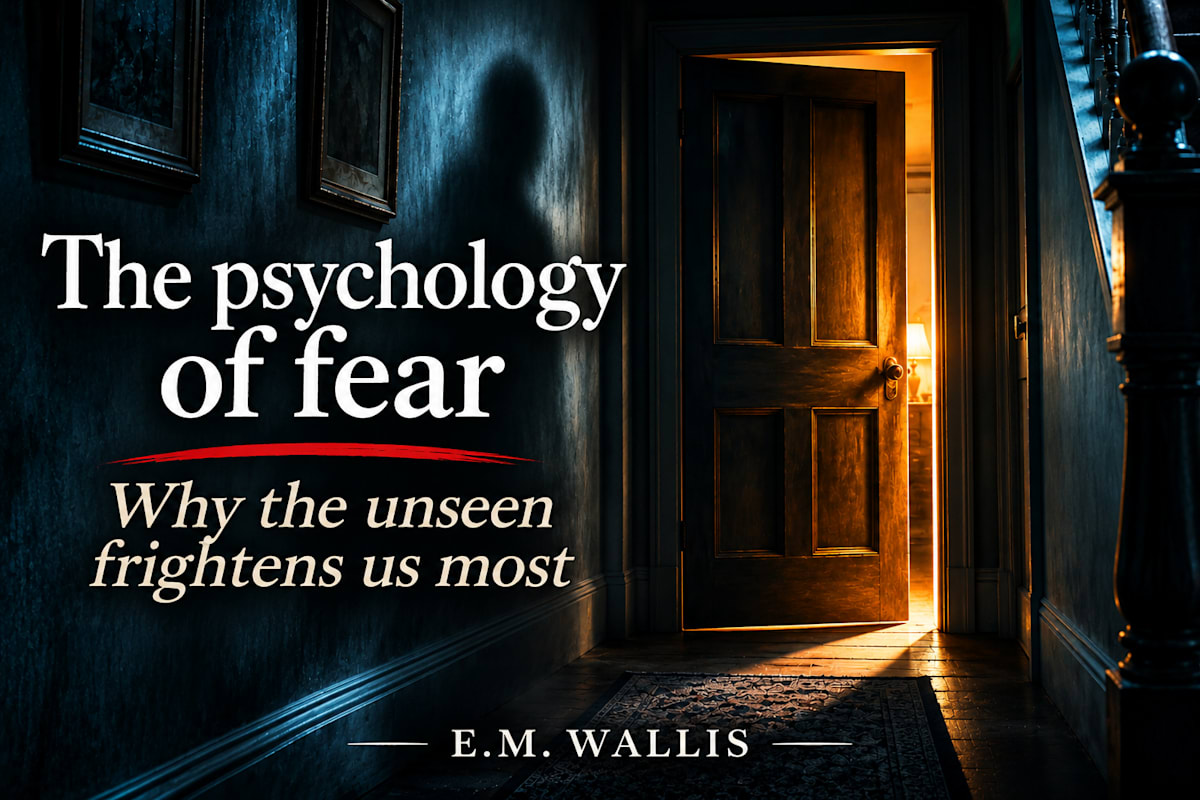
Why can an unexplained sound, a shadow in an empty room or a mysterious telephone call be more frightening than anything we can actually see? Supernatural mystery author E.M. Wallis explores the psychology of fear and the extraordinary power of the imagination.
The sound in the darkness
You're alone in the house. It's late, the lights are off and everything is quiet. Then you hear something upstairs.
A footstep, perhaps. A faint creak of the floorboards. Nothing particularly dramatic, but enough to make you stop what you're doing and listen.
You tell yourself there's a perfectly reasonable explanation. Houses make noises. Timber expands and contracts. Sound travels in strange ways.
Then you hear it again and suddenly, your imagination begins to work overtime.
Who, or what, could be upstairs? Did you remember to lock the door? Was that really a footstep, or are you simply imagining things?
The remarkable thing is that nothing frightening has actually happened. You haven't seen an intruder, encountered a ghost or witnessed anything that proves you're in danger.
Yet your heart is beating faster.
That's the fascinating thing about fear. Sometimes, what we imagine is considerably more frightening than what we see.
As a writer of supernatural mysteries, it's something I find endlessly intriguing. The most effective ghost stories don't necessarily need terrifying apparitions or spectacular paranormal events. Sometimes, all they need is a suggestion that something isn't quite right.
And a reader willing to imagine what might happen next.
Why our brains fear the unknown
Fear is one of our most important survival mechanisms. It helps us recognise potential danger and prepares us to respond when something threatens our safety.
However, our brains don't always wait for proof that a threat exists.
When we encounter something unexpected or difficult to explain, our minds begin searching for possibilities. We draw upon memories, experiences and expectations to work out what might be happening.
This ability is extraordinarily useful. It allows us to anticipate danger rather than waiting until it's too late.
Unfortunately, it also means we can frighten ourselves with possibilities that exist entirely in our imagination.
Consider walking through a dark woodland. During daylight, the trees and undergrowth might seem perfectly ordinary. At night, those same surroundings become unfamiliar. Shadows obscure familiar shapes, small sounds become difficult to identify and our ability to assess the environment is reduced.
The uncertainty makes us more alert. We begin paying attention to things we might otherwise ignore. A branch snapping. Leaves rustling. A movement somewhere beyond the reach of our torch.
Our minds try to fill in the missing information, sometimes with the most threatening explanation available. For a supernatural mystery writer, that process is a wonderful source of inspiration, because the reader doesn't need to see the danger. They only need to believe it might be there.
The power of anticipation
One of the most effective techniques in suspense fiction is delaying the moment when a mystery is revealed.
Imagine a character standing outside a locked bedroom. They can hear someone moving inside, but they know the house has been empty for years.
What happens next?
The obvious approach would be to have the character open the door and reveal whatever is waiting on the other side.
However, consider the alternative.
The character reaches for the handle, hesitates and listens. The movement stops. They call out, but nobody answers. Then, just as they begin to convince themselves they've imagined everything, something gently turns the handle from the other side.
We still haven't seen anything, yet the tension has increased.
That's because anticipation encourages readers to participate in the story. They begin constructing possible explanations, imagining outcomes and wondering whether the character is about to make a terrible mistake.
Psychologists sometimes describe our tendency to anticipate threatening outcomes as part of the brain's response to uncertainty. When information is incomplete, our expectations can shape how we interpret what happens next.
In fiction, that gives the writer an opportunity to create suspense without revealing the source of the threat.
Sometimes, the moment before the door opens is more frightening than whatever might be standing behind it.
Why shadows and silence are so effective
Darkness has featured in frightening stories for centuries, and there's a good reason for that.
When we cannot see clearly, we lose information that would normally help us understand our surroundings. Familiar objects become ambiguous. Ordinary shapes can appear threatening, and movement is harder to interpret.
A coat hanging behind a door might briefly resemble a person. A reflection in a window might look like someone standing outside.
Our brains are particularly good at recognising patterns, including human faces and figures, even when the available information is incomplete.
This tendency, known as pareidolia, helps explain why people sometimes perceive recognisable shapes in shadows, clouds or random patterns.
It also gives supernatural writers a useful tool.
A shadow doesn't need to move to become unsettling. It simply needs to resemble something that shouldn't be there.
Silence can be equally powerful.
We often associate quiet surroundings with safety and relaxation, but silence can become uncomfortable when we're expecting something to happen.
Think about a scene in which a character hears footsteps following them. The footsteps stop whenever they stop.
Eventually, the character turns around.
Nothing.
The absence of sound suddenly becomes more disturbing than the footsteps themselves.
Why?
Because the silence doesn't provide an explanation.
It simply leaves the character, and the reader, waiting.
The fear of losing control
There's another reason supernatural mysteries can be so effective.
They challenge our understanding of how the world works.
Most of us move through life with certain expectations. We understand that doors don't normally open by themselves, photographs don't change when nobody is looking and people who died decades ago cannot telephone us.
Those assumptions help make the world feel predictable.
But what happens when something appears to contradict them?
In my book The Last Caller, Jacob is a helpline operator whose life begins to unravel after he receives a mysterious telephone call from a woman who should not be able to contact him.
The telephone itself is completely ordinary. It's something we use every day without giving it much thought.
However, the identity of the caller transforms that familiar object into the centre of a disturbing mystery.
What interests me about this premise isn't simply the possibility of communication beyond death. It's the effect that possibility has on Jacob's understanding of his own life.
As he searches for answers, he begins uncovering secrets that challenge everything he thought he knew about his past.
The supernatural becomes the catalyst for something deeply personal and that's where I believe some of the strongest mysteries are found.
Not simply in the fear of encountering something impossible, but in the fear that the things we've always believed might not be true.
You can discover The Last Caller on Amazon or explore more of my writing on my author website.
When the imagination becomes the storyteller
One of the things I enjoy most about writing supernatural fiction is deciding how much information to give the reader.
Explain too much, and the mystery can lose its power. Reveal too little, and the story risks becoming frustrating rather than intriguing.
The challenge is finding the balance.
I want readers to have enough information to become invested in the mystery, but I also want their imaginations to contribute something to the experience.
In Whispers in the Fog, Lillie's disturbing psychic visions draw her into a murder mystery on Misthaven Island.
Her experiences raise questions about what can be trusted. Are her visions revealing something important? How can she distinguish between what she believes she's witnessed and what others are prepared to accept?
The uncertainty creates tension because both the character and the reader are searching for answers.
In my short story GHOSTED, I explore supernatural mystery in a more concentrated form. Short fiction doesn't offer the same space for gradual development as a novel, so atmosphere, suggestion and carefully chosen details become particularly important.
I enjoy the idea that readers might finish the story and spend a few moments considering what they've just experienced.
Perhaps they'll revisit an earlier detail in their minds.
Perhaps they'll wonder whether something they initially dismissed was more important than it appeared.
Or perhaps they'll glance towards the nearest darkened doorway.
Any of those reactions would make me happy.
You can also read my earlier article, GHOSTED: The story behind my supernatural mystery, where I explore the ideas and creative thinking behind the short story.
Why the supernatural feels personal
Although ghosts and unexplained events provide the atmosphere for supernatural fiction, I believe the most compelling stories are ultimately about people.
Fear is rarely experienced in isolation from our emotions.
We're frightened of losing the people we love. We worry about the consequences of our decisions. We carry regrets, unresolved questions and memories that can influence us long after the events themselves have passed.
Supernatural fiction provides a way of exploring those experiences through extraordinary circumstances.
A haunting might be connected to grief. A mysterious apparition might represent an unresolved injustice. An unexplained message might force someone to confront a secret they've spent years avoiding.
The supernatural event attracts our attention, but the emotional consequences keep us invested.
That's something my background in journalism and public health communications has reinforced.
People are complicated. Their fears and motivations aren't always immediately apparent, and their reactions to difficult situations can be influenced by experiences that others know nothing about.
When I write fiction, I try to remember that even the most extraordinary circumstances need believable human responses.
A character who encounters something impossible shouldn't simply accept it because the plot requires them to.
They should question it, challenge it and struggle to understand what it means.
Just as we might.
Why we enjoy being frightened
If fear is designed to protect us from danger, why do so many people enjoy ghost stories, psychological thrillers and supernatural mysteries?
Part of the answer lies in the difference between experiencing danger and imagining it within a safe environment.
When we read a frightening story, we can experience suspense, uncertainty and emotional excitement while knowing that the events aren't actually happening to us.
We can explore threatening possibilities without facing the same real-world consequences.
There's also the satisfaction of solving a mystery.
Human beings are naturally curious. We want to understand why something happened, what caused it and whether the explanation fits the evidence.
Supernatural mysteries combine that curiosity with the possibility that the answer might challenge our understanding of reality.
For me, that's what makes the genre so appealing.
I don't necessarily want to frighten readers with every page.
I want to intrigue them.
I want them to question what they're reading, consider different explanations and feel compelled to discover the truth.
And occasionally, I want them to wonder whether turning on another light might be a sensible precaution.
Discover my supernatural mysteries
If you enjoy stories that combine psychological suspense, unexplained events and secrets that refuse to remain buried, you might enjoy exploring my fiction.
Whispers in the Fog
On the mysterious Misthaven Island, Lillie's psychic visions draw her into a murder investigation where her extraordinary experiences could lead her towards the truth or make her the focus of suspicion.
Explore Whispers in the Fog on Amazon
GHOSTED
An atmospheric supernatural mystery short story for readers who enjoy the unsettling space between the ordinary and the unexplained.
The Last Caller
When helpline operator Jacob receives an impossible telephone call, he becomes entangled in a decades-old mystery involving a devastating house fire, concealed family connections and disturbing questions about his own identity.
Discover The Last Caller on Amazon
You can also visit my author website for more articles about supernatural fiction, writing, book recommendations and the stories behind my books.
One final thought
The next time you hear an unexplained noise in an empty house, notice a strange shadow or feel that someone might be watching you, consider what's actually making you uneasy.
Is it something you've seen?
Or is it something you've imagined?
Because our minds have an extraordinary ability to transform uncertainty into fear.
And sometimes, the most frightening thing in a room isn't what might be hiding in the darkness.
It's what our imagination puts there.
E.M. Wallis
Author of Whispers in the Fog, GHOSTED and The Last Caller