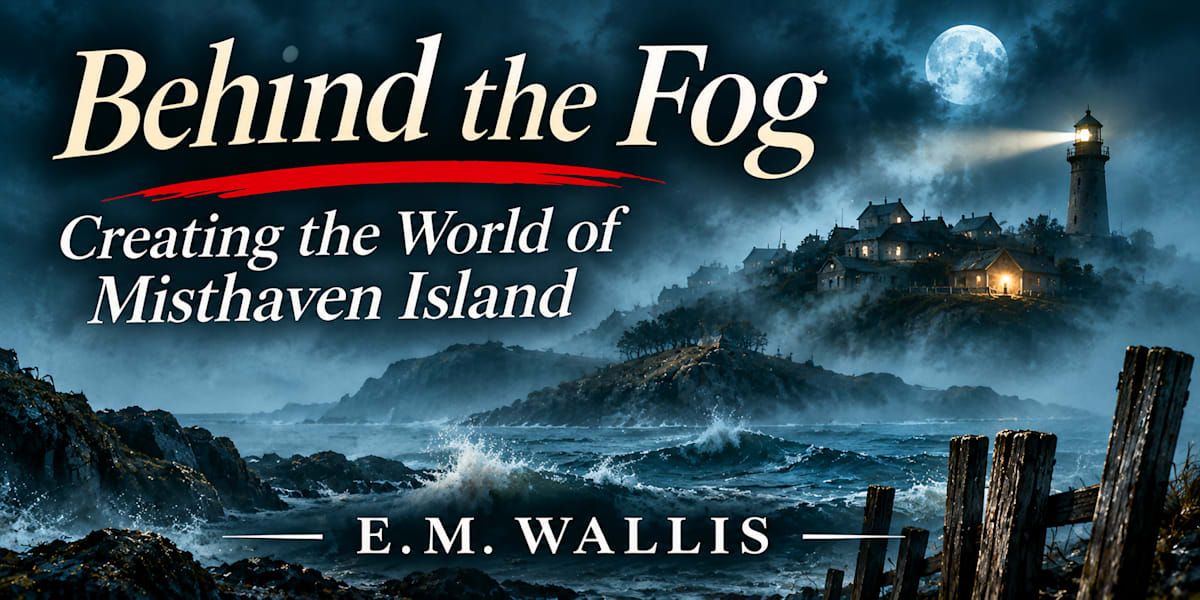
An isolated island, a young woman troubled by psychic visions and a murder mystery where nothing is quite as it seems. Author E.M. Wallis explores the thinking behind Misthaven Island, the atmospheric setting of his supernatural mystery novel, Whispers in the Fog.
An island with secrets
There's something about an island that appeals to the imagination. Perhaps it's the isolation, knowing that the mainland is somewhere beyond the horizon but reaching it isn't always straightforward or perhaps it's the sense of a community living within its own boundaries, where people have known one another for years and the past is never quite as distant as it seems.
I've always found coastal landscapes fascinating. On a bright summer afternoon, they can be beautiful, welcoming places.
But change the weather, bring in the mist and allow the light to fade, and that same stretch of coastline becomes something entirely different. Distances become difficult to judge, buildings disappear into the fog and sounds carry across the water without revealing where they came from.
Somewhere beyond the mist, something might be waiting.
When I developed Whispers in the Fog, I wanted a setting that could create this sense of uncertainty without relying on the supernatural at every turn. Misthaven Island gave me that opportunity, but it needed to become more than an atmospheric backdrop.
I wanted somewhere people could imagine living, with its own history and secrets that might be better left undisturbed. Most importantly, it had to be a place where the mystery could unfold naturally, with the island itself influencing what happened to the people staying there.
Why an island?
One of the challenges of writing a mystery is finding believable ways to create tension. Characters need reasons to become involved in events, obstacles to overcome and, occasionally, circumstances that make walking away rather more difficult than it sounds.
An island provides some of those possibilities almost automatically.
There's a physical separation from the outside world, even if that distance is relatively small. People can't necessarily come and go whenever they please, weather can interfere with travel and information might circulate within the community long before it reaches anyone elsewhere.
But the psychological isolation interests me even more. In a small community, people often believe they know their neighbours. They recognise familiar faces, understand local relationships and remember events that happened years earlier.
That familiarity can be comforting, but it can also be deceptive.
What if someone has spent years concealing something important? What if a respected member of the community isn't quite the person everyone believes them to be? And what happens when someone begins asking questions that local people would prefer not to answer?
These are the questions that offer enormous possibilities for a mystery writer. When someone who has lived in a community all their life discovers that the place they thought they knew is hiding something extraordinary, even the most familiar relationships can become uncertain.
Introduce psychic visions and an unexplained murder into that environment, and the possibilities become even more interesting.
The importance of making Misthaven believable
I've always believed that supernatural fiction works best when the world surrounding the extraordinary events feels convincing. Readers may be willing to accept a ghost, a vision or something that apparently defies explanation, but they still need to believe in the people and places around it.
If everything is strange, nothing feels particularly strange.
That's why I think it's important to establish a recognisable world before disrupting it. An island community needs the same ordinary concerns as anywhere else. People have jobs, families, friendships and disagreements. They worry about money, relationships and what other people think of them.
Some enjoy living somewhere relatively isolated, while others might dream of escaping. Some have deep roots in the community, while others have arrived more recently.
And, like any community, people have their own versions of the past, shaped by memory, experience and sometimes a little selective interpretation.
I wanted Misthaven to feel like somewhere that could exist beyond the pages of the novel. Not simply a collection of locations where important scenes happen, but a place where everyday life continues even while something deeply unsettling is unfolding.
That contrast is important because a murder mystery becomes more compelling when it interrupts a world that otherwise feels normal. The supernatural, too, becomes more convincing when it emerges from circumstances the reader recognises rather than a world where extraordinary events are simply expected.
The fog changes everything
I couldn't write about Misthaven Island without discussing the fog. It's there in the title, after all, but I wanted it to do more than provide a convenient way of making the island look mysterious.
Fog changes the way we experience a place.
A familiar road becomes difficult to recognise, a building that should be visible from a distance disappears and sounds seem closer or further away than they really are. Our imaginations begin filling in the details we can no longer see.
A shadow in the distance might be a person, a tree or something entirely different. Until the mist clears, neither the character nor the reader can be certain, and that uncertainty creates opportunities for suspense without requiring anything particularly dramatic to happen.
There's another reason fog appeals to me, though. It works as a metaphor for the mystery itself, because when a story begins, the reader sees only part of the picture.
There are questions without answers, events without explanations and characters whose motivations remain uncertain. As the investigation progresses, some of those uncertainties begin to disappear, revealing details that were previously hidden.
But sometimes, what becomes visible is considerably more disturbing than anything the reader imagined.
That's the kind of mystery I enjoy writing. One where each discovery provides an answer while raising another question, and where the truth, when it finally emerges, changes our understanding of everything that came before.
Lillie and the problem of knowing too much
At the heart of Whispers in the Fog is Lillie, a young woman whose disturbing psychic visions draw her into a murder mystery. I've always been interested in characters who experience something they cannot easily explain, particularly when that experience creates more problems than it solves.
Imagine knowing something about an event you couldn't possibly have witnessed. Perhaps you've seen a place you've never visited, or experienced a vision that appears connected to something terrible.
You might believe the experience is genuine, but convincing anyone else is another matter.
And what happens if the information you possess makes other people suspicious of you?
For Lillie, the visions create uncertainty rather than providing a straightforward solution. They suggest that something important is hidden beneath the surface, but understanding what they mean is difficult enough without having to persuade other people to take them seriously.
As suspicion begins to fall upon her, the consequences become increasingly personal. I wanted that tension to sit at the centre of the story because having unusual knowledge doesn't necessarily make someone powerful.
Sometimes it makes them vulnerable.
A character who knows something they shouldn't can find themselves facing difficult questions about where the information came from, why they possess it and what they might be concealing. In a close-knit island community, those questions can become particularly dangerous.
Once people begin to suspect someone, even perfectly ordinary behaviour can start to look suspicious. A chance encounter, an unexplained absence or an unfortunate coincidence might suddenly appear significant, particularly when people are already searching for someone to blame.
Discover Whispers in the Fog on Amazon
When everybody knows everybody
There's a particular kind of tension that comes from setting a mystery within a small community. In a large city, anonymity is relatively easy. People can move through their lives without attracting much attention and may know very little about those living a few doors away.
A smaller community can be quite different.
People notice changes in behaviour, know who has fallen out with whom and remember relationships, disagreements and events that might otherwise have been forgotten. At least, they remember their version of those events.
And that's where things become interesting.
Memory isn't always reliable. People can witness the same incident and interpret it differently, while details become exaggerated through repeated retelling or disappear entirely. Sometimes a community develops a shared understanding of something that turns out to be completely wrong.
For a mystery writer, that creates plenty of opportunities.
A character might believe they're protecting someone by keeping quiet, while another has convinced themselves that an uncomfortable event happened differently from the way it actually did. Someone else might know the truth but have spent years ensuring nobody discovers it.
Their reasons may be understandable, selfish or somewhere between the two, but the consequences of their silence can affect people who know nothing about the original events.
The island setting allows those relationships and histories to become part of the mystery. Misthaven isn't simply somewhere a crime has taken place. It's a community whose relationships, memories and secrets help shape the events that follow.
The supernatural should raise questions
One of the decisions I make when writing supernatural fiction is how much to explain. There's a temptation to establish rules for everything, from how psychic visions work and why certain people experience them to whether they can be trusted and what causes the unexplained events.
Sometimes those explanations are necessary, but I think too much certainty can weaken a mystery.
The unexplained is interesting precisely because it challenges our understanding, and providing immediate answers removes some of that uncertainty. In Whispers in the Fog, Lillie's visions are important to the story, but they don't remove the need for investigation.
Characters still have to make decisions, examine information and confront uncomfortable possibilities, even when something apparently supernatural offers a glimpse of the truth.
I didn't want the visions to become a convenient way of solving every problem. Instead, they needed to complicate the situation, raising questions that might otherwise never have been asked.
A vision might reveal something important, but interpreting it correctly is another matter. Even if Lillie understands what she's experienced, persuading other people to believe her creates an entirely different challenge.
That's where the supernatural and the human mystery begin to overlap.
The unexplained event may be extraordinary, but the reactions it provokes are recognisably human, involving doubt, suspicion, fear and the desire to protect ourselves from uncomfortable truths.
The island as a character
Writers sometimes describe a setting as being a character in its own right. It's a phrase that's probably overused, but I think there's some truth in it because a location can influence the decisions people make and shape the way they understand their circumstances.
An isolated island does all three. Its geography affects movement, its weather influences the atmosphere and its community creates relationships and expectations. Its history can also become part of the mystery, particularly when past events continue to influence the present.
When those elements work together, the setting stops feeling like somewhere the writer has simply placed the characters. It becomes part of the story's structure, influencing what people know, how they behave and the choices available to them.
I explored this idea more broadly in my earlier article, When ordinary places become extraordinary: The importance of setting in supernatural fiction.
Misthaven is a good example of why I find the relationship between character and setting so important. Lillie's experiences would create uncertainty wherever she lived, but on an island where reputations matter and people may have known one another for years, that uncertainty takes on a different significance.
The setting changes the consequences of the mystery, affecting not only the investigation but also the way other people respond to Lillie.
That's exactly what I wanted it to do.
My journalism background and the search for truth
My background as a journalist has influenced the way I approach fiction, particularly mysteries. Journalism teaches you to ask questions, examine evidence and consider whether the information you've been given tells the whole story.
Who knows what, how do they know it and what evidence supports their account? Perhaps most importantly, what isn't being said? Those questions are just as useful when developing a fictional murder mystery as they are when investigating a real event.
Every character has a perspective, and those perspectives aren't necessarily reliable.
Some people may be mistaken, others deliberately misleading, while someone else might tell the truth but leave out the one detail that would change everything.
I've always found that particularly interesting because a person doesn't necessarily need to lie to conceal something. They can answer a question accurately while avoiding the issue that matters, or describe what they witnessed without explaining why they were there.
They might even provide a perfectly reasonable account of events that encourages everyone to draw the wrong conclusion. From the outside, their explanation appears convincing, but the reader gradually begins to notice that something doesn't quite fit.
When writing a mystery, I enjoy considering what each character knows, what they believe and what they're prepared to reveal. Just as importantly, I think about what might make them change their mind and whether discovering the truth would actually be in their interests.
On Misthaven Island, where the community's past and present are closely connected, those questions become especially relevant.
The truth may be hidden, but it rarely exists in isolation. It affects people, and people have reasons for wanting it discovered or concealed.
How much should a reader see?
Something else I enjoy about writing mysteries is deciding when to reveal information. Give the reader too much too early and the mystery loses its momentum, but withhold everything and the story risks becoming frustrating.
The challenge is finding the balance.
I like giving readers enough information to begin forming their own theories, while ensuring there's still something important they haven't understood.
A conversation might contain a detail that seems unimportant at first, a character might react unexpectedly to a question or something that appears to be a coincidence might take on greater significance later. Readers notice these things, even if they don't immediately understand them.
That's part of the pleasure of reading a mystery. You're not simply following the characters through a series of events, but trying to work things out alongside them, examining the same clues and occasionally reaching very different conclusions.
In supernatural fiction, that process becomes even more interesting because readers must also decide how much of the unexplained they're prepared to accept.
Is something genuinely paranormal, could there be a rational explanation or is the supernatural event concealing a much more human secret?
I enjoy leaving those questions open long enough for readers to consider different possibilities. After all, a mystery is much more satisfying when the answers feel earned rather than appearing simply because the author has decided it's time to reveal them.
The stories hidden beneath the surface
There's another reason I find island settings so appealing. They suggest that every place has a history extending far beyond the events of the novel, shaped by generations of people whose lives have left their mark on the community.
Relationships have developed and ended, decisions have been made and mistakes have been concealed. The consequences of those events may still influence the people living there today, even when the original circumstances have been forgotten.
I don't think every part of that history needs to appear on the page.
In fact, it can be more effective when readers sense that there's more to a place than the story explicitly reveals, allowing them to imagine the lives and events that have shaped it.
A brief reference to something that happened years earlier, an uncomfortable silence when a particular name is mentioned or a disagreement that seems to have no obvious explanation can suggest a much larger world.
Those details make the setting feel lived in, and sometimes they provide the first indication that the past is about to become important again. Something apparently insignificant may eventually reveal a connection to events that nobody expected to revisit.
In Whispers in the Fog, the island's atmosphere and sense of concealed history contribute to the unfolding murder mystery. The supernatural adds another layer of uncertainty, but beneath it all are the recognisable human concerns that interest me most.
Trust, suspicion, relationships and the consequences of secrets that refuse to remain buried.
Those are the things that give the mystery its meaning, because even when the events themselves are extraordinary, the emotions and motivations behind them remain familiar.
What Misthaven taught me about writing
Every story teaches its author something. Sometimes it's about structure or pacing, sometimes it's about understanding a character's motivations, and occasionally it's about discovering that the setting you've created has a much greater influence on the story than you originally anticipated.
Writing Whispers in the Fog reinforced my belief that atmosphere works best when it grows naturally from the world and the characters.
Fog is useful, but fog alone doesn't create a compelling mystery, just as an isolated island provides little tension unless its isolation affects the people living there.
Psychic visions can introduce fascinating questions, but those questions become meaningful only when they have consequences for the person experiencing them. The different elements need to work together rather than competing for the reader's attention.
Setting, character, mystery and the supernatural all have their part to play. When they complement one another, readers become immersed in a world that feels believable even when extraordinary things begin to happen.
That's what I wanted to achieve with Misthaven Island.
Somewhere readers could imagine visiting, perhaps enjoying a peaceful afternoon exploring the coastline or watching the sea from a sheltered spot.
But perhaps somewhere they'd think twice about remaining after the fog begins to roll in.
Discover Whispers in the Fog
If you enjoy supernatural mysteries involving psychic visions, murder investigations and communities with secrets to hide, Whispers in the Fog might be your next read.
Set on the isolated Misthaven Island, the novel follows Lillie as her disturbing visions draw her into a mystery that threatens to overwhelm her. As suspicion grows and the island's secrets begin to emerge, she must confront events that challenge her understanding of what is possible.
Read Whispers in the Fog on Amazon
You can also explore my other supernatural fiction.
The Last Caller
A bereavement support worker receives a telephone call from a woman who should be dead, leading him towards a devastating fire, concealed family relationships and disturbing truths about his past.
Discover The Last Caller on Amazon
GHOSTED
An atmospheric supernatural mystery short story exploring the unsettling space between everyday life and the unexplained.
For more articles about supernatural mysteries, writing and the inspiration behind my fiction, visit my author website.
One final thought
Imagine standing on the shore of Misthaven Island. The sea is calm and somewhere behind you, the ordinary routines of island life continue. There's nothing particularly threatening about the scene, and for a moment it could be any peaceful coastal community.
Then the fog begins to move in.
The mainland disappears, the familiar coastline becomes difficult to recognise and somewhere beyond the mist, you hear something you cannot explain. Perhaps it's nothing, or perhaps there's a perfectly reasonable explanation that simply isn't obvious.
Or perhaps the island has been keeping a secret.
Would you investigate, ask the locals what they know or decide that some mysteries are better left alone? It's a question I enjoy leaving with readers because their answer might reveal as much about them as it does about the story.
That's the wonderful thing about creating a fictional world. I can build the island, introduce the characters and begin revealing its secrets, but once readers arrive, Misthaven becomes somewhere they experience for themselves.
And what they imagine might be waiting in the fog could be far more unsettling than anything I could describe.
Welcome to Misthaven Island.
Just remember, not everything is as it seems.
E.M. Wallis
Author of Whispers in the Fog, The Last Caller and GHOSTED