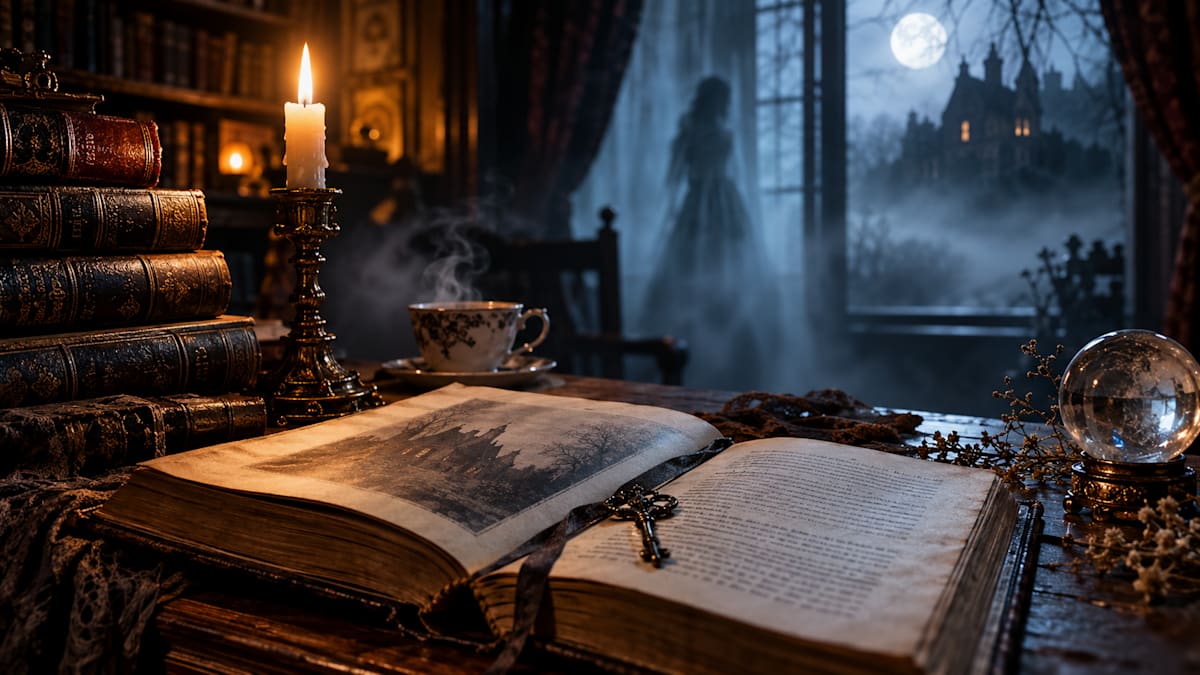
Why do we enjoy being frightened by things we cannot explain? From haunted houses to voices from beyond the grave, E.M. Wallis explores the psychology of ghost stories and why the supernatural continues to captivate our imaginations.
There's something wonderfully contradictory about our relationship with ghost stories. We know we're reading fiction, yet we still glance towards the darkened doorway. We understand that the footsteps belong to a character in a book, yet the slightest creak from the landing suddenly demands our attention.
Why do we do it? Why do we willingly invite fear into our lives, particularly when the world already provides more than enough reasons to be frightened?
Perhaps the answer lies not in our fascination with death, but in our relationship with the unknown.
As an author of supernatural mysteries, I've often wondered why we find the unexplained so compelling. It's a fascination that runs through my own fiction, from the psychic visions and hidden secrets of Whispers in the Fog to the unsettling mysteries of GHOSTED and the impossible telephone calls at the heart of The Last Caller.
For me, the appeal has never been simply about frightening readers. It's about what happens when ordinary people encounter something that challenges everything they believe.
And perhaps, somewhere beneath our enjoyment of a good ghost story, we're searching for answers to questions that have troubled humanity for centuries.
The pleasure of being frightened
Fear is an emotion most of us spend our lives trying to avoid. We lock our doors, look both ways before crossing the road and generally do our best to steer clear of anything that might threaten our safety.
Yet give us a frightening book, a ghost story or a supernatural thriller, and suddenly we're perfectly happy to experience fear from the comfort of our favourite armchair.
Psychologists sometimes describe this as recreational fear. When we know we're physically safe, frightening experiences can become exciting rather than overwhelming. Our bodies may respond with a racing heartbeat or heightened alertness, but another part of our minds understands that we can close the book whenever we choose.
That distinction matters. The danger feels real enough to capture our attention, but not so real that we have to escape it.
Of course, not everyone enjoys being frightened, and even those of us who do have our limits. Some readers prefer the gentle unease of a traditional ghost story, while others relish the intensity of a psychological thriller. The attraction lies partly in finding the level of fear that feels exciting rather than distressing.
For writers, this creates an interesting challenge. How do you make readers feel threatened while ensuring they remain eager to turn the page?
I believe the answer often lies in anticipation rather than confrontation.
A shadow moving across a doorway can be more disturbing than the creature that eventually emerges from it. Footsteps in an empty room can create more tension than a dramatic supernatural confrontation. The reader's imagination begins filling the gaps, often creating something far more frightening than anything the author could describe.
Sometimes, the most terrifying thing in a ghost story is what we never actually see.
Why the unknown frightens us more than the familiar
Human beings like explanations. We want to understand why things happen, what causes them and how we can prevent them from happening again.
The supernatural challenges that desire for certainty.
Imagine waking in the middle of the night to hear someone walking across the landing. You live alone. The house is locked. There should be nobody there.
Your mind immediately begins searching for explanations. Perhaps it's the central heating. Perhaps a neighbour's footsteps are carrying through the walls. Perhaps you're still half asleep.
But what happens when none of those explanations seems convincing?
That is where the supernatural mystery begins.
The most effective ghost stories exploit the uncomfortable space between what we know and what we fear might be possible. They rarely need to establish beyond doubt that ghosts exist. Instead, they invite us to consider the possibility that our understanding of the world might be incomplete.
Consider Shirley Jackson's The Haunting of Hill House, where the psychological condition of the characters becomes almost inseparable from the strange events surrounding them. Or Susan Hill's The Woman in Black, where an isolated house, a bleak landscape and a mysterious figure create an atmosphere of gathering dread.
Both demonstrate that uncertainty can be a powerful storytelling device.
As a writer, I find this particularly fascinating because the supernatural allows us to challenge a character's most deeply held assumptions. Once someone begins questioning what is real, everything else in their life can become uncertain.
And that uncertainty creates the foundations for a compelling mystery.
When ordinary things become extraordinary
One of the reasons ghost stories can be so effective is that they often begin with something entirely familiar.
A photograph. A child's toy. An old letter. A telephone ringing in the middle of the night.
None of these things are particularly frightening on their own. We encounter them regularly without giving them a second thought. However place an ordinary object in an extraordinary situation, and its meaning can change completely.
Imagine finding an old photograph in which someone appears who could not possibly have been present or discovering a letter written in the handwriting of a person who died many years earlier.
The object itself hasn't changed. What has changed is our understanding of it.
That idea lies at the heart of my supernatural mystery The Last Caller.
Jacob works as a helpline operator, accustomed to answering calls from people who need someone to listen. It is an ordinary responsibility, grounded in human connection and the simple act of offering support.
Then he receives a call that should never have been possible.
A mysterious woman named Veronica draws him into a decades-old investigation involving a devastating house fire, buried family secrets and questions about his own identity.
What begins as an apparently impossible telephone call becomes something far more personal. Jacob isn't simply trying to discover who is calling him. He's trying to understand why the caller knows things about his life that he doesn't know himself.
For me, that is where supernatural fiction becomes particularly interesting. The unexplained event opens the door, but the human mystery encourages us to keep walking through it.
After all, what could be more unsettling than discovering that a stranger knows more about your past than you do?
Ghost stories are often about grief and loss
Although we tend to associate ghost stories with fear, many of them are also deeply emotional.
Think about what a ghost represents. Someone who was once alive. Someone who had relationships, ambitions, regrets and experiences. Someone whose life ended, but whose presence somehow remains.
The idea of a ghost touches upon one of humanity's oldest questions: what happens when we die?
For some people, the possibility of life beyond death offers comfort. For others, it raises unsettling questions about what might remain unfinished. Ghost stories can explore both reactions, sometimes within the same narrative.
They also provide a way of examining grief, memory and the difficulty of letting go.
A haunting might represent an injustice that was never resolved. A mysterious apparition might be connected to a family secret. A voice from the past might be seeking forgiveness, recognition or simply the opportunity to be heard.
In that sense, supernatural fiction often explores experiences that are entirely human, even when the events themselves are impossible.
The emotional weight of a ghost story doesn't necessarily come from the ghost. It comes from understanding why that presence matters to the living.
This is one of the themes I enjoy exploring in my writing. Behind the supernatural mystery, there is often a person struggling with loss, guilt, uncertainty or a truth they would rather avoid.
The ghost may provide the mystery, but the human experience gives it meaning.
Why we love secrets that refuse to stay buried
A good mystery promises that something important has been concealed.
Perhaps a family has protected a terrible secret for generations. Perhaps a disappearance was never properly investigated. Perhaps an apparently ordinary community has built its existence around a lie.
Whatever the circumstances, readers are invited to become investigators.
We examine clues, question motives and search for connections between events. Every revelation offers the possibility of understanding what really happened.
Supernatural mysteries add another dimension because the clues themselves may challenge conventional explanations.
In Whispers in the Fog, I explore this through Lillie, a young woman whose disturbing psychic visions become entangled with a murder investigation on the mist-shrouded Misthaven Island.
Her experiences raise difficult questions. Can she trust what she sees? Will anyone believe her? And what happens when the very thing that might help uncover the truth also makes her a suspect?
The island setting adds another layer to the mystery. Isolation, suspicion and the secrets of a close-knit community create an atmosphere in which the past feels dangerously close to the present.
For me, this combination of supernatural uncertainty and human deception is particularly compelling.
A ghost story might ask whether the dead can return. A mystery asks why something happened.
Bring those questions together, and the possibilities become almost endless.
The power of atmosphere
Ask readers what they remember most vividly about their favourite ghost stories, and many will describe a place.
A deserted mansion. A fog-covered moor. An abandoned school. A lonely stretch of coastline where the sea disappears into the mist.
Setting has an extraordinary ability to influence how we experience fiction.
A house that feels welcoming in daylight can become threatening after dark. A familiar road can seem entirely different when the streetlights fail. A room that once offered comfort can become unsettling when something inexplicable happens inside it.
Writers use these contrasts to create atmosphere, allowing ordinary surroundings to acquire an unfamiliar significance.
I have always been drawn to locations that seem to possess their own histories. Places where the past feels close enough to touch and where silence suggests that something important has been left unsaid.
But atmosphere is about more than darkness, fog and abandoned buildings.
It is about expectation.
The reader senses that something is wrong long before the characters understand what it might be. A detail appears slightly out of place. A conversation ends too abruptly. Someone refuses to answer an apparently innocent question.
Gradually, those small disturbances accumulate until even the most ordinary moment carries an undercurrent of tension.
When that happens, the setting becomes more than a backdrop. It becomes an active part of the story.
Do we really want all the answers?
There is a temptation when writing mysteries to explain everything.
Every clue must have a purpose. Every question should lead towards a revelation. Every secret must eventually be exposed.
And certainly, readers deserve satisfying resolutions to the central mysteries of a story.
But supernatural fiction offers an interesting exception.
Sometimes, a little uncertainty can make an ending more memorable.
If every unexplained event receives a straightforward explanation, the extraordinary may begin to feel ordinary again. The mystery has been solved, but some of its power has disappeared.
That doesn't mean abandoning the reader or introducing confusion for its own sake. It means recognising that there is a difference between resolving a character's story and explaining every aspect of the supernatural world they have encountered.
A character might discover the truth about their family, confront a terrible injustice or finally understand the significance of a mysterious event.
However, does that necessarily mean they must understand everything?
I don't think so.
Some of the most memorable supernatural stories leave us with one final question, a lingering uncertainty that follows us beyond the last page.
Perhaps that's why we sometimes find ourselves thinking about a ghost story years after reading it.
The book may be closed, but the mystery remains.
Perhaps we want to believe
There is another possibility worth considering.
Perhaps our fascination with ghost stories comes partly from wanting to believe that the world contains more than we can explain.
Human beings have told stories about spirits, apparitions and encounters with the dead for thousands of years. These traditions vary enormously between cultures, but they share a fascination with the possibility that existence extends beyond the boundaries of ordinary experience.
Modern science has provided explanations for many phenomena once attributed to supernatural forces. Yet ghost stories remain popular, and people continue to report experiences they find difficult to understand.
That doesn't establish that ghosts exist. It does suggest that our fascination with the unknown is unlikely to disappear.
And perhaps it shouldn't.
Imagination encourages us to ask questions, explore possibilities and consider experiences beyond our own. Fiction gives us the freedom to do those things without requiring us to accept every possibility as fact.
We can enjoy a ghost story without believing in ghosts. We can be frightened by a fictional haunting while knowing that the author created every word.
And we can still glance towards the doorway when the house makes an unexpected noise.
Just in case.
The ghost story is here to stay
The popularity of supernatural fiction suggests that our appetite for the unexplained is far from exhausted.
New generations of writers continue to reinterpret familiar themes, combining traditional hauntings with psychological suspense, crime investigations, family dramas and contemporary anxieties.
The settings change. The characters evolve. The methods of storytelling develop.
But the fundamental questions remain remarkably consistent.
What lies beyond our understanding? Can the past ever truly be buried? What happens when something impossible intrudes upon an ordinary life?
And perhaps most importantly, what would we do if it happened to us?
For me, that is the enduring appeal of supernatural mystery fiction. It allows us to explore fear, loss, guilt, hope and the extraordinary complexity of human behaviour through stories that challenge our understanding of reality.
A good ghost story doesn't simply make us afraid of the dark.
It makes us wonder what might be waiting within it.
Enjoy a good supernatural mystery? Discover my books
If you've ever found yourself drawn to stories about ghosts, unexplained events and secrets that refuse to remain buried, perhaps I can tempt you with something from my own imagination.
My supernatural fiction explores the unsettling space between the ordinary and the extraordinary, where the past refuses to stay silent and even the most familiar things can become deeply disturbing.
On the mist-shrouded Misthaven Island, Lillie's psychic visions draw her into a disturbing mystery involving murder, suspicion and secrets hidden beneath the surface of an apparently ordinary community.
As danger grows, she must discover whether her extraordinary experiences can help reveal the truth before they destroy her.
For readers who enjoy shorter supernatural fiction, GHOSTED offers a journey into the unexplained, exploring the unsettling possibility that the world contains more than we can see or understand.
A supernatural mystery short story for anyone who enjoys atmosphere, intrigue and the unexpected.
Some calls should never be answered. Especially those from the dead.
When helpline operator Jacob receives a mysterious telephone call, he becomes entangled in a decades-old mystery involving a devastating house fire, hidden family connections and a woman whose voice should not be reaching him.
With the help of his friend Raj, Jacob begins uncovering a disturbing history of deception, guilt and betrayal. But as the truth emerges, he discovers that the greatest mystery may concern his own past.
The Last Caller combines supernatural mystery, psychological suspense and dark family secrets in a haunting story about identity, loss and the consequences of long-buried lies.
Explore the books of E.M. Wallis and discover your next supernatural mystery.
What Do You Think?
Have you ever read a ghost story that genuinely frightened you? Perhaps you've experienced something you still cannot explain, or maybe you simply enjoy the thrill of a supernatural mystery from the safety of your favourite reading chair.
I'd love to hear your thoughts.
Why do you think we love ghost stories?
You can get in touch here: Contact E.M. Wallis
E.M. Wallis
Author of Whispers in the Fog, GHOSTED and The Last Caller