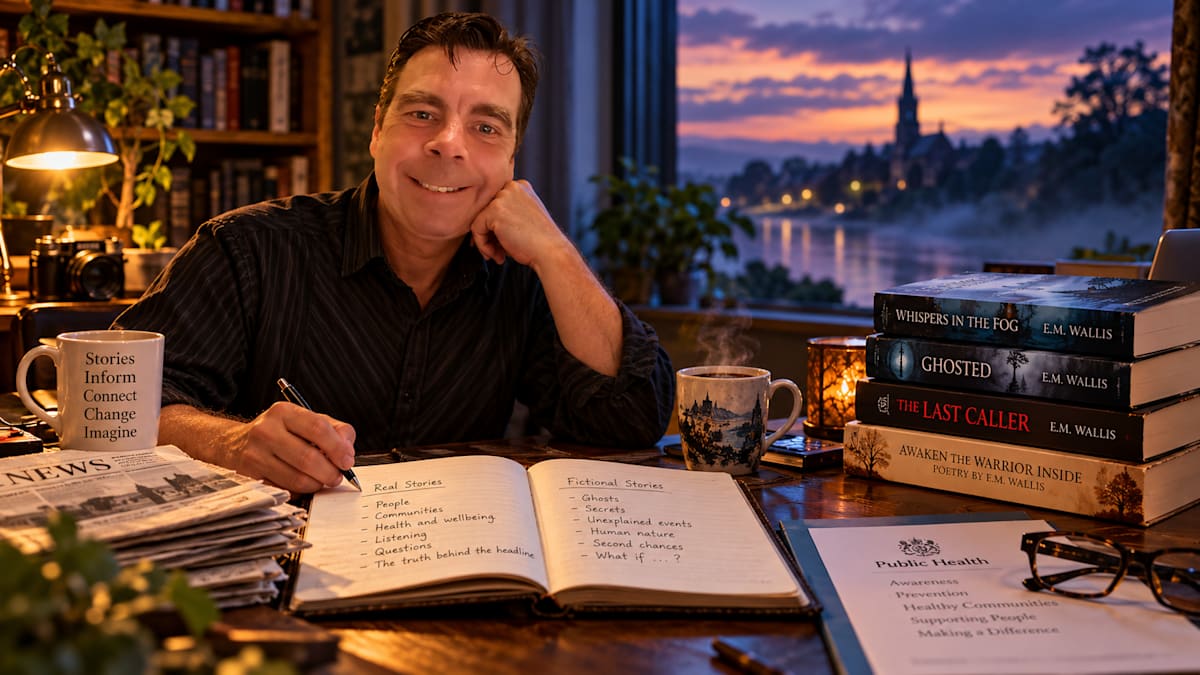
From the newsroom to public health communications and supernatural mysteries, E.M. Wallis reflects on a career spent telling stories and the experiences that have shaped his fiction.
I've spent much of my working life telling stories. Some were factual, others were intended to inform, explain or encourage people to take action. More recently, I've found myself telling stories about things that may not exist at all.
Ghosts, unexplained events, mysterious telephone calls and secrets that refuse to remain buried.
I'm E.M. Wallis, a British author, journalist and Public Health Communications Officer whose fascination with human behaviour has found its way into supernatural fiction.
My novel Whispers in the Fog takes readers to the mist-shrouded Misthaven Island, where psychic visions, murder and buried secrets threaten to destroy a young woman's life. My short story GHOSTED explores the unsettling space between the ordinary and the unexplained, while my latest novel, The Last Caller, follows a helpline operator whose mysterious telephone calls uncover a disturbing history of deception, guilt and family secrets.
At first glance, these stories might seem a world away from journalism and public health communications.
But the more I think about it, the more I realise they have something fundamental in common, they all begin with people. Their experiences, their motivations, their fears and the decisions that shape their lives.
The journalist's instinct
Journalism teaches you to be curious. You learn to ask questions, examine information and look beyond the obvious explanation. You discover that the first version of a story isn't necessarily the complete version, and that sometimes the most revealing detail emerges from an apparently insignificant remark.
You also learn the importance of listening. Not simply waiting for someone to finish speaking so you can ask your next question, but listening for the things that matter. The hesitation before an answer. The detail someone returns to repeatedly. The emotion behind a seemingly ordinary statement.
A good journalist understands that facts are essential, but facts alone don't always explain why a story matters. It's the human experience behind those facts that gives them meaning.
That understanding has stayed with me throughout my career and continues to influence the fictional characters I create. Real people are complicated. Their motivations are sometimes contradictory, and their decisions are influenced by experiences that aren't immediately apparent.
For a fiction writer, that complexity is invaluable.
From journalism to public health communications
Most recently, my professional career has taken me into local government, working as a Public Health Communications Officer.
It's a role that has brought together many of the skills I developed through journalism, but with an additional responsibility. Rather than simply reporting on issues affecting people's lives, I've been involved in communicating information intended to improve health, raise awareness, encourage positive behaviour change and help people access support.
My work has covered subjects including domestic abuse, alcohol-related harm and preventative health services. These are issues that require more than an eye-catching headline or a carefully worded press release. They require understanding people.
Why might someone ignore an important health message? What prevents a person from asking for support? How do fear, stigma and personal experience influence the decisions we make?
And how can we communicate in a way that encourages someone to take a positive step without making them feel judged?
These questions have fascinated me professionally, but they've also influenced my approach to fiction.
A compelling character isn't necessarily someone who makes the right decisions. Often, it's someone whose choices we can understand, even when we disagree with them.
And sometimes, the most interesting part of a story is what a character chooses not to say.
When facts give way to imagination
There is a wonderful freedom in fiction. As a journalist, you cannot invent an event because it would make the story more interesting. In public health communications, you cannot exaggerate evidence simply because it might persuade more people to act. Accuracy and credibility are essential.
Fiction removes those particular restrictions, but replaces them with a different responsibility. The world you create must make sense on its own terms. Characters need motivations, events need consequences and revelations must feel earned.
For someone accustomed to asking questions and searching for answers, mystery fiction feels like a natural progression.
The difference is that, as a novelist, I get to create the questions in the first place and because I write supernatural mysteries, I can occasionally break the rules of reality.
That's where things become particularly enjoyable.
Why the supernatural?
I've always been fascinated by the things we cannot easily explain. Not necessarily because I believe every ghost story or paranormal account, but because uncertainty can be such a powerful starting point for storytelling.
Imagine hearing footsteps in an empty house. There might be a perfectly reasonable explanation. Perhaps the building is settling, or sound is travelling from somewhere unexpected.
But what if there isn't? That simple question opens the door to countless possibilities.
The supernatural also provides a way of exploring very human experiences. Grief, guilt, regret, love and the consequences of past decisions can all become central to a ghost story.
In Whispers in the Fog, Lillie's psychic visions raise questions about truth, trust and what happens when someone experiences something nobody else is prepared to believe.
In The Last Caller, a mysterious telephone call becomes the beginning of an investigation into Jacob's own identity. What interests me most about the premise isn't simply the possibility of a voice from beyond the grave. It's what happens when someone discovers that their understanding of their own past may be completely wrong.
The ghost is often only the beginning.
The real story lies in what happens to the living.
More than novels
Although supernatural fiction occupies a significant part of my imagination, it isn't the only way I enjoy telling stories.
My poetry collection, Awaken the Warrior Inside, explores courage, resilience and the human experience through a different form of writing.
Songwriting offers another creative outlet. A song needs to establish a mood, develop an idea and create an emotional connection within a relatively short space of time. Sometimes it tells a complete story. Sometimes it captures a single moment or feeling.
I enjoy moving between these different forms because each teaches me something about the others.
Journalism encourages precision. Public health communications reinforces the importance of audience and empathy. Fiction encourages imagination. Poetry teaches economy of language, while songwriting reminds me of the importance of rhythm and emotion.
All of them depend on finding the right words.
The life of an independent author
Writing a book is one thing. Getting people to discover it is another.
As an independent author, I've learned that completing a manuscript is only part of the journey. There are covers to consider, descriptions to write, publishing decisions to make and the ongoing challenge of introducing your work to readers who have never heard of you.
That's one of the reasons I've developed this author website.
I want it to be more than a place where visitors can find links to my books. I want to share the ideas behind my writing, explore the supernatural mysteries that have influenced the genre and introduce readers to stories and authors they might otherwise never discover.
If someone arrives here looking for a recommendation and leaves having found a new favourite book, I'll consider that worthwhile.
And if they happen to discover one of mine along the way, so much the better.
Still learning, still writing
I don't think there is a point at which a writer stops learning. Every story presents a new challenge, every character develops in unexpected ways and every completed manuscript offers lessons that become useful when the next blank page appears.
But the fascination remains.
There is something remarkable about beginning with an idea that exists only in your imagination and gradually transforming it into a world that another person can enter.
A character who didn't exist begins to feel real. A place you've invented acquires a history. A mystery develops until even you find yourself eager to reach the next revelation.
Eventually, someone you've never met opens the book and begins reading. For a while, they inhabit a world you created. I find that an extraordinary privilege.
My journey from journalism through public health communications and into fiction hasn't been a departure from storytelling. It's been a continuation of it, using different methods, different audiences and occasionally allowing the impossible to become possible.
I still ask questions. I still look for the story beneath the surface. And I still believe that words, carefully chosen and thoughtfully arranged, have the power to make people feel something.
The only real difference is that these days, some of the people I interview exist entirely in my imagination.
And occasionally, they're dead.
Discover my Books
If you've enjoyed reading about my journey from journalism to fiction, perhaps you'd like to explore some of the stories that have emerged along the way.
Whispers in the Fog: A supernatural mystery set on Misthaven Island, where psychic visions, murder and long-buried secrets draw Lillie into a dangerous search for the truth.
GHOSTED: A supernatural mystery short story exploring the unsettling space between the ordinary and the unexplained.
The Last Caller: When a helpline operator receives a mysterious telephone call from a woman who should not be able to reach him, he becomes entangled in a decades-old mystery involving a devastating fire, family secrets and a past he never knew existed.
Awaken the Warrior Inside: A poetry collection exploring courage, resilience and the human experience.
Explore my books and discover more about the stories behind them.
Let's Talk About Stories
Have you ever thought about writing a book? Perhaps you've changed careers, discovered a creative passion later in life or found that experiences from one part of your life have unexpectedly influenced another.
I'd love to hear about it - you can contact me here: Contact | E.M. Wallis
After all, everyone has a story.
Some of us simply can't resist writing them down.
Author, poet, songwriter and storyteller